
China Telecom recently established a Token Office (词元办公室), reportedly the first of its kind among Chinese state-owned enterprises. It's fair to say tokens are now a strategic asset.
At first glance, this looks like the beginning of a new era, but I think we are already at the beginning of its end.
The token economy is a transitional phase, not a destination.
To understand why, we need to begin somewhere seemingly unrelated: geopolitical chokepoints.
01. The New Chokepoints
Every civilization organizes itself around geographic bottlenecks: the chokepoints.
The British Empire understood maritime chokepoints better than anyone. The United States inherited much of that strategic architecture postwar.
A chokepoint is a narrow passage: straits, canals, sometimes mountain passes.
Here are a famous few.
Malacca, the strait between Malaysia and Indonesia, through which roughly 80% of China's imported oil still flows. Also called the Malacca Dilemma.
Then there are the Suez Canal, the recently storied Panama Canal, the Strait of Hormuz and dozens of lesser-known mountain passes, pipelines and maritime corridors.
The map of chokepoints largely defines today's global trade, macro and geopolitical orders. But that map is becoming obsolete.
Different Maps Being Drawn
In South America.
Chancay, for example, a new port in Peru, can send Brazilian soy and Chilean copper straight to Shanghai, bypassing Panama and LA entirely.
Look north.
The Arctic Route, once dismissed as a geopolitical curiosity, is gradually becoming a viable shipping route as ice conditions change. It can cut 40% off the Suez load.
Then look inland.
Today, more than 82 rail routes link China to 200+ European cities via Kazakhstan and Russia, the so-called "Iron Silk Road."
Alongside it, the Middle Corridor provides another path through the Caspian, reducing dependence on both Russia and the Red Sea.
Meanwhile, the International North-South Transport Corridor (INSTC) links India, Iran, Central Asia and Russia while bypassing the Suez Canal altogether.
Industry-Specific Routes
The most striking one is that industries are starting to build their own sector-specific routes, from electric vehicles and lithium to semiconductors.
Material mined in Kazakhstan can move to processing hubs in China before finished EVs travel by rail directly to the European market in roughly half the time required by traditional sea freight.
The Non-Geographic Chokepoints
If you look beyond borders, an entirely different map of chokepoints appears.
Rare earth processing. Semiconductor fabrication. Advanced packaging.
Recently, I just learned that ultra-high-voltage transmission technology, moving power a thousand miles with almost no loss, can be another proprietary export.
The new chokepoint of the AI era isn't a strait. It's the chips and the grid.
02. Inference Economy: Silicon, Training Method and Input Data
Three Bets Against Brute Force of Compute
Recently even Western mainstream media don't deny that China has built a best-in-class energy transition case among nations. China is probably the only country that can pull off a project like East Data, West Computing (东数西算) at national scale.
If energy is the new chokepoint, the obvious move for China would be to double down on the energy-draining token economy: export its high energy capacity to win the token economy outright.
Instead, China appears to be making a different bet.
Read Qiushi
If you want to understand Beijing's political thinking, you read Qiushi (求是).
A recent Qiushi article, titled 准确把握人工智能发展前沿与竞争格局 ("Accurately grasping the technological frontiers and competitive landscape of AI"), indicates China's overall AI strategy: 效率优先 (efficiency first), 算力精准供给 (precision compute allocation by workload).
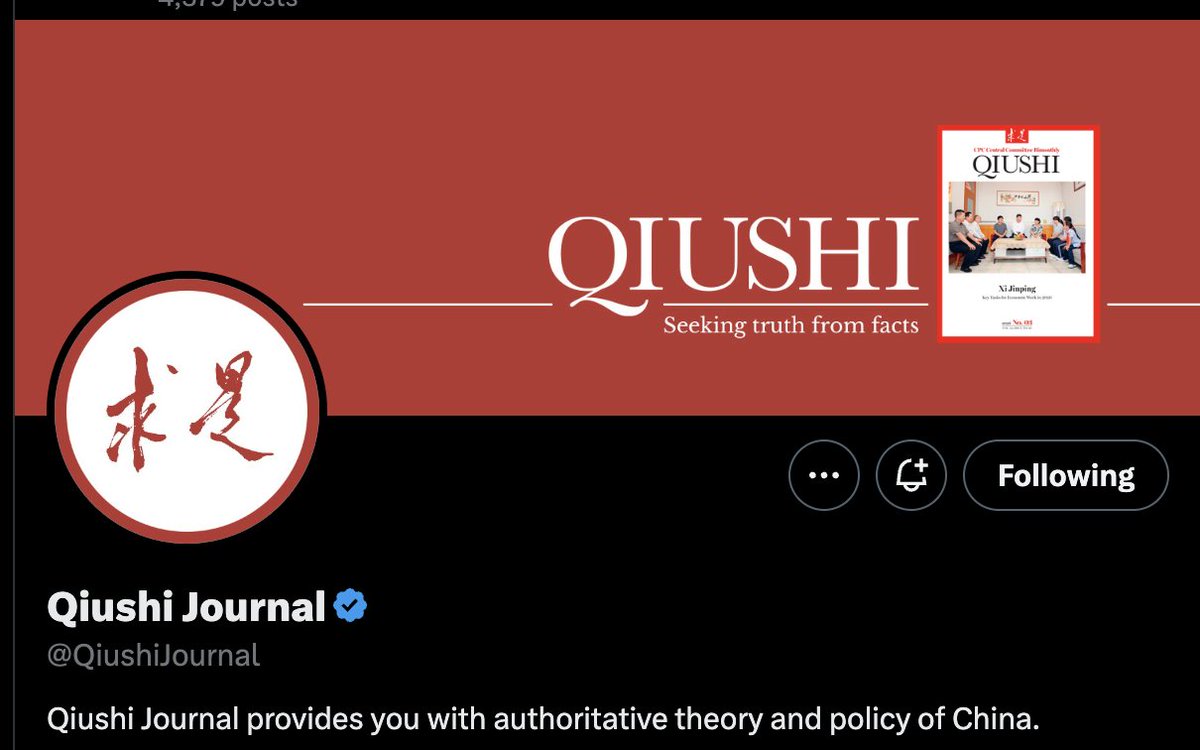
My read: this article shows Beijing has now developed its own doctrine language for AI strategy. It's the ultimate counter to Washington's chip strategy, which assumes one move: training parity. Match GPU for GPU. Guard the frontier with export controls.
China is placing a different bet: build inference chips. Run models cheaply at scale, not train them from scratch.
Inference Chips
A 5-year-old learning math for the first time by solving thousands of practice problems is running on a training chip. That same kid, grown up, taking a quick math quiz using what they already know, is an inference chip.
Inference chips optimize for low-latency, low-bandwidth single forward passes over raw compute: one fixed, frozen set of weights, run once per query.
DeepSeek, already running on Huawei's Ascend chips, is now developing its own custom inference chip, a move mirrored by peers like OpenAI (partnering with Broadcom). Due to sanctions, DeepSeek's ASIC relies on 7nm manufacturing constraints, leaning on architectural cleverness over bleeding-edge hardware.
This is a masterclass in silicon-software co-design, thanks to Multi-Head Latent Attention (MLA), an algorithm that reduces the memory-heavy KV vector cache by 90%. By embedding math directly into physics, the chip bypasses the need for expensive High-Bandwidth Memory (HBM) and radically speeds up memory access.
On July 20, while I was editing this piece, The Information reported Google is building its own inference-only chip, "Frozen v2," descended from a Jeff Dean design.
Frozen v2 takes this software-chip co-design approach to the extreme: it permanently etches Gemini's neural network architecture directly into the hardware circuits. It sacrifices TPU flexibility for a reported 6-to-10x leap in power efficiency. By freezing the model architecture into silicon, the chip shortens the physical distance data has to travel to calculate tokens, further proof that the future of inference is chips tailored entirely to one model's math.
The transformer is done evolving. The model is the chip now.
Efficiency Over Hyperscale
That's on the chip front. But hardware is only half the battle.
While I was speaking at Stanford, news broke: Kimi K3, Moonshot AI's 2.8-trillion-parameter open-weight model, had gone toe-to-toe with Anthropic's flagship Fable on the frontend.
While tech giants spend billions chasing dense, hyperscale clusters, K3 delivers another extreme hardware-software optimization for cost-saving. According to Moonshot's own blog, K3 features:
- Only call in the specialists you need (Hyper-Sparse MoE): routing tasks to just 16 out of 896 total experts instead of activating its entire network.
- Do the math with rounder numbers (Hardware-Native Quantization): K3 bakes in MXFP4, a compressed numerical format, directly into its design to slash memory bandwidth.
But these are just the skeleton. I think the true engine behind K3's intelligence is a fundamental pivot in how it was taught: learn by grading, not guessing (end-to-end agentic reinforcement learning).
As X user Zephyr put it in a July 2026 X thread: if true, what these "Mercor-type" firms do is to bypass simple data scraping and instead pay domain experts, scientists, elite engineers and senior developers to build rigorous reinforcement-learning environments: verified problems, graded by someone who actually knows the field.
So instead of forcing a model to spend millions of GPU hours predicting the next word, K3 was trained in sandboxes of verified problems, graded by human experts.
Efficiency is the new hyperscale.
Data Over Compute
A further blow to our obsession with raw compute: data.
For two years, the industry measured AI progress in cluster sizes. Dr. Fei-Fei Li has been arguing the opposite.
In an interview with Tim Ferriss, she makes the point simply: just as children learn by observing the real world rather than running raw calculations, AI systems need rich, high-quality, spatial data to truly understand the world.

In her recent essay, she argues language models train on a representation of a representation. Language captures meaning but strips out physics, geometry and causality. Her thesis: spatial intelligence, built from sensor data, is the next frontier, not just another modality.
This echoes the recent murmuring: "AI X," AI embedded into a specific industry, like manufacturing, logistics and healthcare.
But there is a glaring roadblock: we do not have an established ontology for that. There is no shared data architecture. Most legacy industries do not even have a common digital language for their own internal data yet.
That gap is coming. It will be won by whoever commands the proprietary sensor data from the real world.
The launch of Kimi K3 might just prove a paradigm shift: the real race on the next frontier is not token but data.
03. Capital Efficiency
Technology has a long history of overcoming technological constraints through new technological breakthroughs, so I don't think the real hurdle of the token economy is technological. The real bottleneck is its ideological capitalization.
One such ideology is effective accelerationism, or e/acc. One of its maxims is: "Capitalism is AI. AI is capitalism" (Nick Land). The logic is that capital is the most efficient system for organizing resources and human behavior, while AI is the most efficient mechanism for organizing capital.
But today's e/acc movement has taken that idea too far. When capitalism dictates AI, and AI reinforces its own financialization, infrastructure becomes a capital game.
When was the last time infrastructure was primarily a capital game? The Rockefeller era. However, that logic only works on this premise: you're the only game in town. And that's probably not what Land originally bet on.
Open-source AI breaks the Rockefeller-era logic.
Last year, on this same conference stage, I was one of the few people highlighting Alibaba's Qwen as a leading open-source model. This year, open source is no longer just a Chinese story.
Mira Murati, OpenAI's former CTO, founded Thinking Machines Lab, which recently released its open-source model, Inkling. The company openly acknowledged that Inkling's foundation model was heavily influenced by, or distilled from, DeepSeek-V3, while its post-training drew on synthetic data generated by Moonshot AI's Kimi K2.5.
If open-source AI still sounds far-fetched for everyday users, let me give you a simple example.
I'm in a Slack community for personal software builders, most of whom run solo businesses or use AI for personal productivity. Someone asked whether anyone still believed the AI doom narrative. One member replied that she had finally abandoned expensive proprietary models after successfully switching to Zhipu's GLM-5.2 and Kimi K2.5, even before K3 was released. She wrote, "If AI doom means the boom-bust of expensive models, so be it." I know she runs a one-person business.
That's the real point. AI should be about production and infrastructure for everyone. Most AI doom narratives seem concentrated in America. For rest of the world, AI is rarely framed as a doomsday story. It's understood primarily as a tool that makes things cheaper, faster and more accessible.
So I think the danger was never AI. It was the over-financialization of AI.
04. An Energy Renaissance
I once founded a media company with Richard Saul Wurman, best known as the founder of TED. He also created many other interesting projects, one of them 19|20|21. Long before big data or AI, the project traced human migration across the 19th, 20th and 21st centuries. The conclusion was unequivocal: human migration, and by extension human civilization, from tools to habitats to literature and art, can all be traced back to one element: water.
Today, it's easy to replace water with tokens in the logic of the token economy. But think about it. Water assembled civilization because it was abundant and accessible. Imagine a world where water was financialized or ideologized. Civilization would never have emerged. Yet those are the two moats sustaining the theory behind the token economy.
If water assembled past human civilization, I believe the post-AI civilization will not be assembled by tokens, but by energy: more precisely, energy abundance.
We are at the dawn of the Energy Renaissance, enabled by AI.
(This article is adapted from a talk I gave on Global Green Development Summit at the Stanford Faculty Club on July 18, 2026.)